
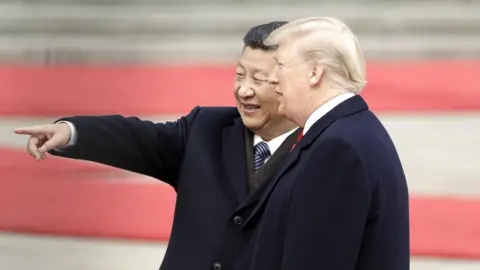
 When China's leader Xi Jinping hosts his American counterpart in Beijing this week, Donald Trump will be reminded of his last visit in 2017 – he was wooed hard, complete with dinner inside the Forbidden City, an honour no US president before him had received.
This week's reception promises to be just as grand, including a stop inside Zhongnanhai, the rarefied compound where China's top leadership lives and works. The agenda too will be just as thorny, with Iran being a new source of tension, alongside trade, technology and Taiwan.
But a lot has changed as Trump returns to a stronger and far more assertive China. Now well into an unprecedented third term, an ambitious Xi has been pushing forward with plans for "new productive forces" with heavy investments in renewable energy, robotics and artificial intelligence.
If the American president and his administration want a glimpse of the future Beijing has been reaching for in the last decade, they have to look beyond the imposing heart of the capital where they will spend much of their time.
In the remote, rugged north, solar and wind power now dominates vast landscapes. In the industrious south, automation is reshaping factories and supply chains, and megacities like Chongqing have become the stuff of influencers' feeds.
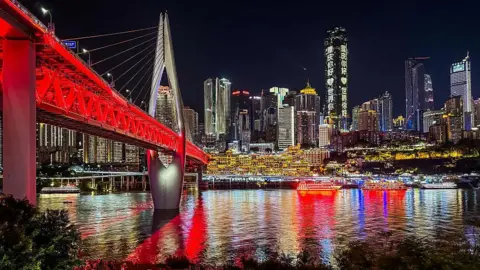
Billions in state funding have transformed Chongqing, a gritty manufacturing hub deep in the south-west into a powerhouse symbol of a changing China that is embracing new tech, new trade and a new adjective – trendy – as it tries to show the world a friendlier face.
Back in 2017, China was trying to prove it was on an equal footing to the US, says Ali Wyne, senior research and advocacy adviser for US-China relations at International Crisis Group.
"I think that the Chinese delegation understandably expended an enormous amount of diplomatic effort trying to convey the impression that President Xi was President Trump's geopolitical equal. What I find striking is that this time around that assertion isn't necessary on the part of Chinese."
Washington now acknowledges China as a "near-peer", says Wyne, who describes Beijing as "arguably the most powerful competitor that the United States has confronted in its history".
Trump, in turn, may well be the most mercurial foreign leader China has ever encountered. He even has a nickname here - Chuan Jianguo, which means "Trump the nation builder". Online many Chinese believe that his divisive policies and trade wars have helped China's rise by weakening America's global standing.
"He doesn't care about the consequences at all," says a middle-aged man on holiday in Chongqing. "He should know that we share the same world. It is a global village. He should not always put America first."
He says he does not want to share his name as he stands among the crowds cramming into vantage points for a view of Chongqing's neon-lit, stacked skyline.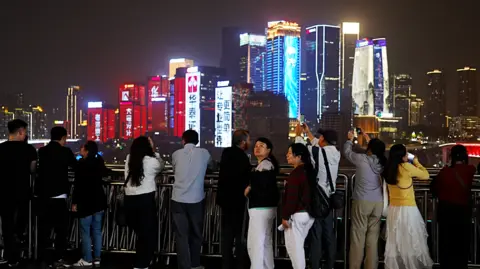
No.31, Zhongnan High-tech Innovation Industrial Park, Jimo District, Qingdao City, Shandong Province


